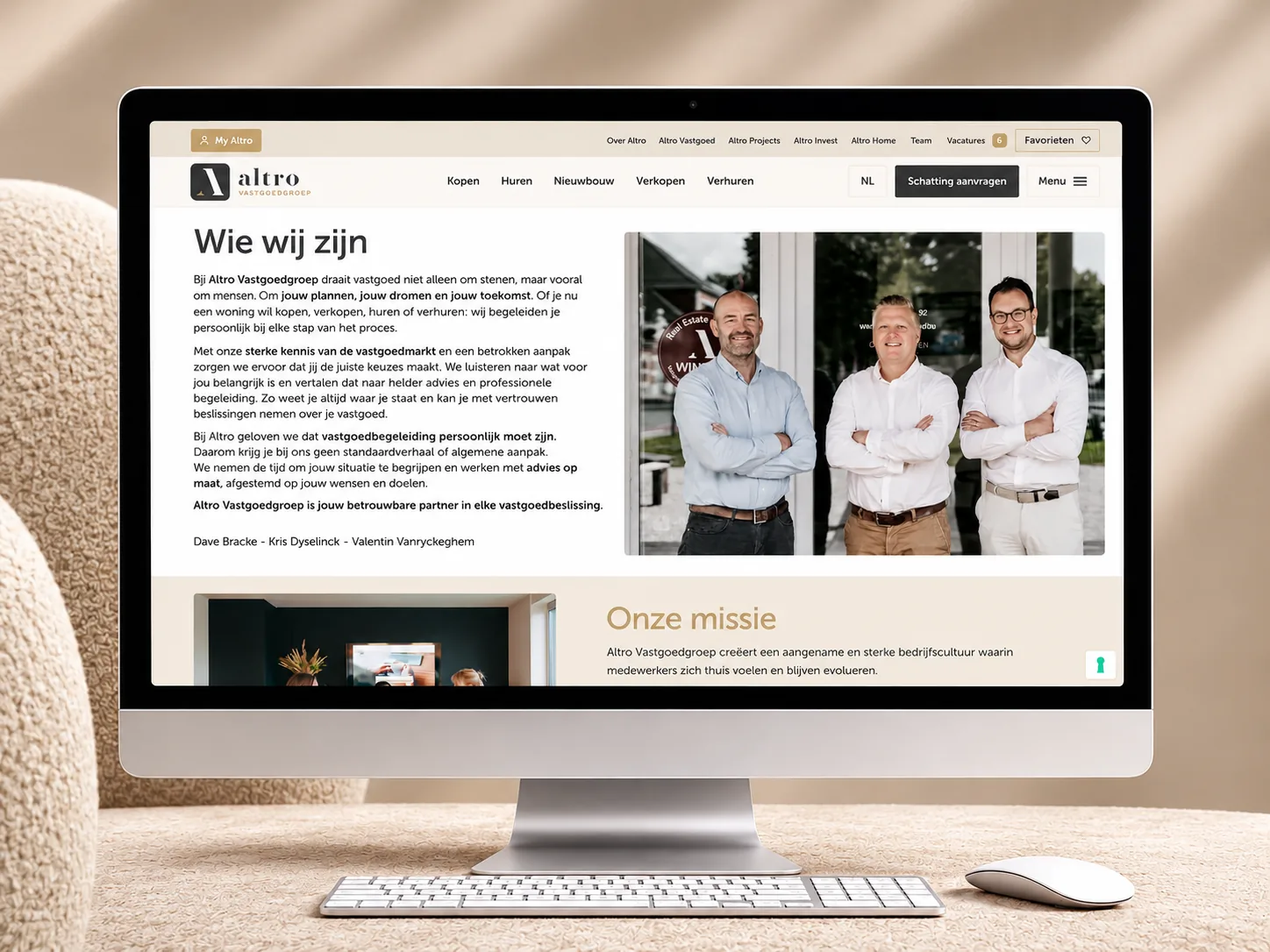
 Wim, Copandi

What changed on 1 October 2026
Since 1 October 2026, a new code of ethics has applied: the BIV's code of ethics. It was approved by royal decree of 20 July 2026 and published in the Belgian Official Gazette on 21 September 2026.
Two changes matter for your website:
- Your third-party account. Your third-party account number appears on your documents and your website, where such an account is required.
- Rules for AI. For the first time, the code includes rules on the use of artificial intelligence. More on that below.
This article is not legal advice. It sets out the rules as the BIV and the government publish them. Unsure about your own situation? Ask the BIV or your legal adviser.
The checklist for your footer and contact page
The code of ethics requires you to show these details on your documents, on paper and electronically, and on your website. The notices required by the Code of Economic Law come on top.
A practical approach: put the essentials in your footer, on every page. Put the full list on your contact page or on a separate legal notices page, and link to it from your footer.
Who you are
- The name of your business, or the name of the legal entity with its legal form
- Your company number, and your VAT number if you are subject to VAT
- The address of your establishment
- Your contact details: telephone and e-mail address
If your agency is a company
- The legal form
- The address of the registered office
- "RLE" or "Register of Legal Entities", followed by the seat of the competent court
Your registration as an estate agent
- Your BIV registration number
- Your professional title: estate agent-intermediary, -syndic and/or -steward
- A statement that your registration was granted in Belgium
- The contact details of the BIV as supervisory authority
Insurance, third-party account and rules
- The name of your insurer for professional liability and surety, with the policy number
- Your third-party account number, where such an account is required
- A reference to the BIV code of ethics, for example with a link
The BIV also recommends showing the terms of use of your website. That puts you in a stronger position if someone copies your listings with a scraper.
EPC in your listings
Every property you put up for sale or to let needs EPC information in the advertisement. That includes your website.
The Flemish government asks for two things:
- The label or the energy score. For a home with an EPC from 2019 or later, you choose the score or the label. For an EPC from before 2019, show the score.
- The address or the unique code. The full address with house or box number, or the unique EPC code.
If a property has poor energy performance and is transferred in full ownership, you must also state that a renovation obligation applies. For homes, that means label E or worse.
The Flemish Energy and Climate Agency (VEKA) carries out spot checks. If the information is missing or wrong, an estate agent risks a fine of €750 to €5,000. New builds without an EPC Bouw fall under a separate rule, which we cover in our article on prices and units in new builds.
With Habbi, Salamander's website platform, your properties come from your estate agency CRM. What is filled in there appears on your website. Fill in the EPC fields in your CRM, and the website follows.
Cookies and privacy
If your website uses cookies, it needs a cookie statement. If you process customer data, you provide information on how you comply with privacy legislation.
That is how VLAIO's overview of what a business website must show puts it. For an estate agent website, you almost always need both: a contact form, a search request or a viewing request all involve personal data.
- A cookie statement, if your website uses cookies
- Information on how you comply with privacy legislation, if you process customer data
What exactly belongs in those statements is outside the scope of this checklist.
AI and images
The new code of ethics has rules on the use of artificial intelligence. We found no separate rule on photos or images.
What it does say:
- You stay responsible. Using AI does not reduce your ethical and legal obligations.
- You review everything critically. You assess carefully what an AI system produces before you use it. Where the law requires it, you are transparent about your use of AI.
- No personal data in an open AI system. And you never use AI to mislead anyone.
The code of ethics also says that in your advertising you must not mislead anyone about the availability and essential features of what you offer. Our advice for images: don't let a photo you edit with AI give a different picture of the property than reality. A renovated kitchen that isn't there, a garden that looks bigger: that does not belong in your listings.
What you need on social media
On your social media page, you show the same details as on your website, with one exception: your third-party account number.
If your page has too little space, add a link to your website, where all the details appear. A link to your contact page or your legal notices page is enough.
- The same details as on your website, without the third-party account
- Or a link to the page on your website where those details appear
- In every advertisement and promotional item: make clear it comes from an estate agent
Read also